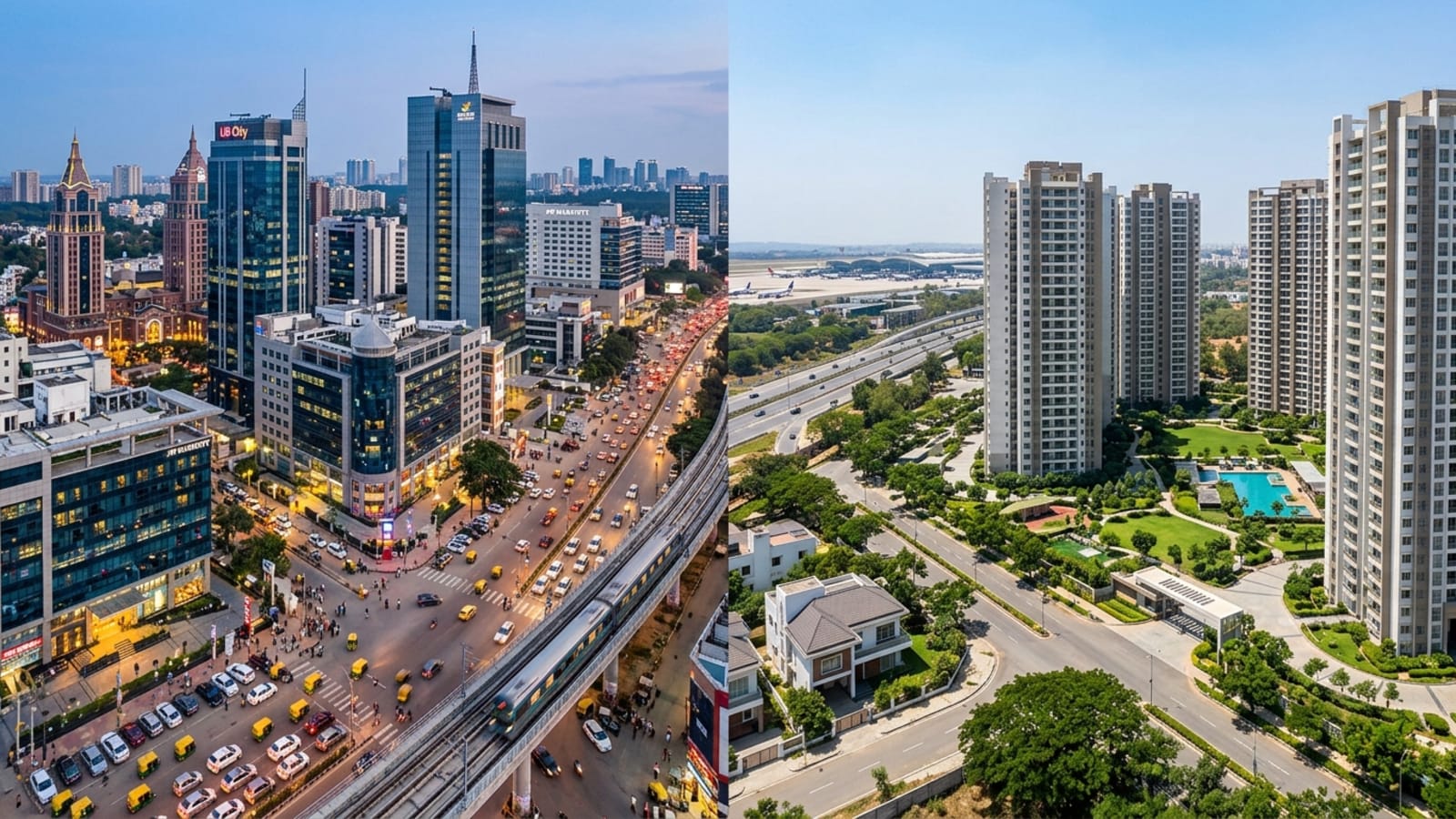
The Case for Owning One Property in CBD and One in North Bangalore
By Rajesh Sadhwani Updated 29 June 2026
Bangalore's luxury market has split into two engines: CBD scarcity for capital preservation, North Bangalore infrastructure for growth and rental yield.
Quick Answer: Owning one property in Bangalore's Central Business District and one in North Bangalore is a portfolio strategy built on two distinct economic engines that move on different cycles. A CBD address on Lavelle Road, Vittal Mallya Road, or Richmond Road is a scarcity asset where supply is fixed and pricing holds through cycles (Free Press Journal, October 2025). A North Bangalore property in the Hebbal-Jakkur-Devanahalli corridor is an infrastructure asset whose value tracks the Airport Metro Blue Line, the Satellite Town Ring Road, and the Aerospace SEZ . The CBD protects capital. North Bangalore compounds it. A serious Bangalore portfolio holds one of each.
TL;DR
CBD (Lavelle Road, Vittal Mallya Road, Richmond Road): Scarcity-driven pricing, fixed inventory, low rental yield of 2-3%, but the strongest store-of-value characteristics in the city.
North Bangalore (Hebbal, Jakkur, Yelahanka, Devanahalli): Infrastructure-led appreciation of 12-15% annually with 4-5% rental yields, anchored to Manyata Tech Park, KIA, and Aerospace SEZ.
Different demand bases: CBD demand is generational and globally-sourced. North Bangalore demand is professional, NRI-led, and airport-anchored.
Different return profiles: CBD delivers capital preservation and intergenerational transfer optionality. North Bangalore delivers capital growth and rental cash flow.
Together, they cover both ends of the wealth equation: the asset that holds value and the asset that creates it.
Bangalore's Luxury Market Has Quietly Split Into Two Engines
Bangalore's residential market changed decisively in 2025. Luxury launches overtook mid-income launches for the first time in H1 FY2026, accounting for 49% of total launches, up from 19% in FY2021 (Business Standard citing ICRA, November 2025). Beneath the headline, two distinct markets now operate in parallel. Central Bangalore commands an average rate of ₹13,960 per square foot, the highest in the city, while North Bangalore averages ₹10,873 per square foot with 10.17% appreciation year-on-year (Square Yards, April 2026).
The CBD is a heritage market constrained by scarcity. North Bangalore is a growth market driven by infrastructure. A portfolio that holds one of each is not diversifying within a category. It is owning two different categories.
The CBD Property: Bangalore's Closest Equivalent to a Land Bank
Central Bangalore is one of the most land-constrained zones in the city. Most new supply comes from redevelopment of older bungalows rather than fresh land parcels, and low-density boutique developments of 10-60 apartments have replaced the larger gated communities found in outer corridors (BookNewProperty, March 2026).
That scarcity is why pricing holds through cycles. In October 2025, Manipal Group Chairman Ranjan Pai's investment arm Esencia Partners acquired a 25,824 square foot Lavelle Road parcel for ₹165.6 crore, working out to approximately ₹64,150 per square foot (Free Press Journal, October 2025). Five years earlier, comparable Lavelle Road land traded at approximately ₹40,000 per square foot, implying a roughly 60% per-square-foot uplift in that window (Construction World, 2024). On Vittal Mallya Road, resale inventory in marquee buildings transacts at ₹42,000 to ₹60,000 per square foot, with branded penthouse deals crossing ₹50 crore (Construction World, 2024).
Rental yields in the CBD sit at 2-3%, lower than every other Bangalore corridor (Square Yards, April 2026). For wealth-preservation buyers, the low yield is the point. The CBD is not bought for monthly income. It is bought because a 4,500 square foot plot held since the 1970s carries embedded redevelopment optionality, because no amount of capital can manufacture more Lavelle Road, and because the buyer profile stays consistent across decades.
The North Bangalore Property: An Infrastructure Compounding Story
If the CBD is a scarcity asset, North Bangalore is its opposite: an infrastructure asset whose price moves with metro stations, ring roads, and aerospace campuses that did not exist a decade ago. The Airport Metro Blue Line, a 37-km stretch connecting Silk Board to Kempegowda International Airport with a ₹14,788 crore budget, is expected operational by mid-to-late 2026 (Devanahalli.co.in, 2026). The 280-km Satellite Town Ring Road is on track for 2025-2026 completion, and the K-RIDE suburban rail network adds 148 km of track connecting the city to Devanahalli (PropertiesNearAirport, March 2026).
The economic base is structural. North Bangalore added more than 50,000 IT and GCC jobs in Q3 2025 . The KIADB Aerospace SEZ now houses Boeing, Airbus, Rolls-Royce, Collins Aerospace, and Hindustan Aeronautics (Crazy Assets, 2025). Hebbal commands ₹11,000 to ₹14,000 per square foot in 2026, Devanahalli averages ₹9,150 per square foot (NewsFirst Prime, February 2026), and plot prices along the airport corridor have appreciated 118% over four years, the highest appreciation band in Bangalore's recent history (PropertiesNearAirport, March 2026).
The rental yield profile is the second differentiator. Devanahalli yields 4.1% to 4.8%, Hebbal and Thanisandra yield 3-4%, and the Aerospace Park belt now touches 4.5-5.2% as Boeing's India Engineering and Technology Center drives rental demand (NewsFirst Prime, February 2026;Purva Northern Lights, March 2026). This is the portfolio's compounding asset. It generates monthly cash flow while the capital base appreciates at 12-15% annually (BookNewProperty, January 2026).
Why The Two Are Genuinely Different Assets
The case for owning both rests on the fact that demand bases, growth drivers, and risk profiles do not overlap.
CBD demand is sourced from a thin pool: established business families, senior corporate leadership, diplomatic missions, and HNW individuals acquiring legacy addresses. Off-market transactions are common, and many high-value Bangalore homes in the ₹40-60 crore band sell without ever reaching public listings. The growth driver is land scarcity. The risk is illiquidity.
North Bangalore demand is broader and more cyclical. The buyer pool includes senior technology professionals at Manyata Tech Park, aerospace engineers at the KIADB SEZ, NRIs flying through KIA, and investors building rental portfolios. The growth driver is infrastructure delivery. The risk is delivery delay.
When the CBD slows, scarcity protects price. When North Bangalore slows, rental yield protects cash flow. A portfolio with both is not duplicating exposure within a city. It is holding two assets that respond differently to economic and demographic shocks.
What ₹15 Crore Buys in Each Corridor
₹15 crore in the CBD buys a 2,500 to 3,000 square foot apartment in a branded Vittal Mallya Road residence or a redevelopment-eligible plot of around 2,000 square feet on a Lavelle Road side-street. The asset yields 2-3% and appreciates at single-digit rates, but holds value through any cycle.
₹15 crore in North Bangalore buys a 4,500 to 5,500 square foot lake-facing 4 BHK in Hebbal, a 10,000 to 7,000 square foot villa in Devanahalli, or a residential plot in the Aerospace Park belt with appreciation still ahead of it. The asset yields 4-5% and appreciates at 12-15%, with higher exposure to delivery and infrastructure execution.
Together, they form the two halves of a serious Bangalore property portfolio.
What to Verify Before Committing
For new projects, confirm RERA Karnataka registration. For CBD resale, verify A-Khata status and request title history going back at least 30 years. For North Bangalore plots, confirm BMRDA or STRR approval, check for clear title from agricultural conversion, and verify proximity to confirmed metro alignment rather than proposed alignment. In both markets, request at least three recent transaction comparables and make sure your advisor can explain the price variance between them.
Frequently asked questions
Is owning two properties in Bangalore better than diversifying across cities?
Owning two properties within Bangalore in genuinely different sub-markets often produces better risk-adjusted returns than spreading across cities. The CBD and North Bangalore corridors are driven by different demand bases and infrastructure cycles, so they behave like separate asset classes within one city.
What is the minimum budget to build a CBD plus North Bangalore portfolio?
A realistic entry point is approximately ₹8-10 crore for a CBD apartment in a branded Lavelle Road or Vittal Mallya Road residence and ₹2-3 crore for a 3 BHK in Hebbal or Jakkur. At higher ticket sizes, the strategy scales into bungalows, villas, and plots.
Which corridor delivers better rental yield in 2026?
North Bangalore consistently outperforms on yield, with Devanahalli at 4.1-4.8%, Hebbal at 3-4%, and the Aerospace Park belt touching 4.5-5.2%. CBD properties yield 2-3%, with the trade-off being scarcity-driven capital preservation rather than monthly cash flow.
How does the Airport Metro Blue Line change the North Bangalore investment case?
37-km Blue Line connecting Silk Board to KIA, expected operational by mid-to-late 2026, has already driven 15-18% rental premiums for properties within 1.5 km of stations like Doddajala, Chikkajala, and Bettahalasuru. It compresses the airport commute to under 30 minutes and structurally re-rates the corridor.
What should I verify before buying in either corridor?
Confirm RERA Karnataka registration, verify A-Khata status, check title history going back at least 30 years for CBD heritage parcels, and confirm BMRDA or STRR approval for North Bangalore plots. Request at least three recent transaction comparables and work with an advisor who can explain pricing variance between them.